


| SBIR/STTR Access |

STAMUS Consulting can assist you in developing proposals and business
development representation on SBIR/STTR solicitations. Congress Passes
Reauthorization of SBIR/STTR/CPP Through September 30, 2017. On
December 12, 2011, Congress officially passed legislation to reauthorize the
SBIR, STTR, and CPP Programs (CPP will now be called CRP,
Commercialization Readiness Program). The bill has been sent to the President
for signature.
The SBA has performed a series of improvements to increase the effectiveness
and efficiency of the overall SBIR program. Together, these improvements
represent a new and improved SBIR, or as the SBA is calling it, "SBIR 2.0".
SBA published in the Federal Register proposed amendments to the SBIR
Program to raise the SBIR Phase I award threshold amount from $100,000 to
$150,000, and the Phase II award threshold amount from $750,000 to
$1,000,000.
development representation on SBIR/STTR solicitations. Congress Passes
Reauthorization of SBIR/STTR/CPP Through September 30, 2017. On
December 12, 2011, Congress officially passed legislation to reauthorize the
SBIR, STTR, and CPP Programs (CPP will now be called CRP,
Commercialization Readiness Program). The bill has been sent to the President
for signature.
The SBA has performed a series of improvements to increase the effectiveness
and efficiency of the overall SBIR program. Together, these improvements
represent a new and improved SBIR, or as the SBA is calling it, "SBIR 2.0".
SBA published in the Federal Register proposed amendments to the SBIR
Program to raise the SBIR Phase I award threshold amount from $100,000 to
$150,000, and the Phase II award threshold amount from $750,000 to
$1,000,000.


 |
 |
 |
 |
 |
 |
 |
 | |  | |  | |  | |  | |  |

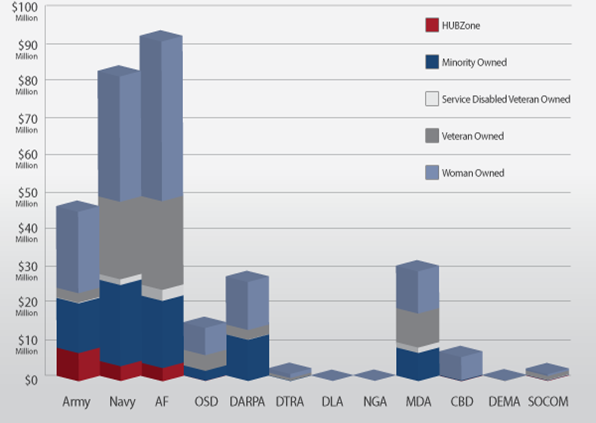
| Socioeconomic Awards by Component (FY 2010) |
Congress established the Small Business Innovation Research (SBIR) program
in 1982 to fund research and development (R&D) by U.S. owned and operated
businesses of less than 500 employees. SBIR, the nation's largest source of
early-stage technology financing, is administered by the Small Business
Administration through 11 federal agencies and is funded at more than $2 billion
annually. The Department of Defense (DoD) accounts for more than half of the
federal government's total SBIR/STTR program.
The DoD SBIR program is made up of 12 participating components: Army,
Navy, Air Force, Missile Defense Agency, Defense Advanced Research Projects
Agency, Chemical Biological Defense, Special Operations Command, Defense
Threat Reduction Agency, National Geospatial-Intelligence Agency, Defense
Logistics Agency, Defense Microelectronics Activity and the Office of Secretary
of Defense.
The three-phase SBIR Program directly funds up to $1.15 million in early-stage
R&D by small companies. Eligible projects must fulfill an R&D need identified
by the DoD and have the potential to be developed into a product or service for
commercial or defense markets.
Three-Phased Program
Phase I (Project feasibility) determines the scientific, technical and commercial
merit and feasibility of the ideas submitted. Phase I contracts are typically
$150,000 over a period of six months. If Phase I proves successful, the company
may be invited to submit a Phase II proposal.
Phase II (Project development to prototype) is the major R&D effort, funding
the prototyping and demonstration of the most promising Phase I projects.
Phase II contracts are up to $1 million and usually span 24 months. Phase II
proposal submissions are by invitation only.
Phase III (Commercialization) is the ultimate goal of the SBIR program. Small
businesses are expected to obtain funding from the private sector or government
sources outside the SBIR program to commercialize the Phase II project for sale
in the military and private sector markets.
in 1982 to fund research and development (R&D) by U.S. owned and operated
businesses of less than 500 employees. SBIR, the nation's largest source of
early-stage technology financing, is administered by the Small Business
Administration through 11 federal agencies and is funded at more than $2 billion
annually. The Department of Defense (DoD) accounts for more than half of the
federal government's total SBIR/STTR program.
The DoD SBIR program is made up of 12 participating components: Army,
Navy, Air Force, Missile Defense Agency, Defense Advanced Research Projects
Agency, Chemical Biological Defense, Special Operations Command, Defense
Threat Reduction Agency, National Geospatial-Intelligence Agency, Defense
Logistics Agency, Defense Microelectronics Activity and the Office of Secretary
of Defense.
The three-phase SBIR Program directly funds up to $1.15 million in early-stage
R&D by small companies. Eligible projects must fulfill an R&D need identified
by the DoD and have the potential to be developed into a product or service for
commercial or defense markets.
Three-Phased Program
Phase I (Project feasibility) determines the scientific, technical and commercial
merit and feasibility of the ideas submitted. Phase I contracts are typically
$150,000 over a period of six months. If Phase I proves successful, the company
may be invited to submit a Phase II proposal.
Phase II (Project development to prototype) is the major R&D effort, funding
the prototyping and demonstration of the most promising Phase I projects.
Phase II contracts are up to $1 million and usually span 24 months. Phase II
proposal submissions are by invitation only.
Phase III (Commercialization) is the ultimate goal of the SBIR program. Small
businesses are expected to obtain funding from the private sector or government
sources outside the SBIR program to commercialize the Phase II project for sale
in the military and private sector markets.
| Small Business Innovation Research (SBIR) |
| Small Business Technology Transfer (STTR) |
| THREE-PHASED PROGRAM |
Congress established the Small Business Technology Transfer (STTR) program
in 1992. Similar in structure to SBIR, STTR provides up to $850,000 in early-
stage R&D funding directly to small companies working cooperatively with
researchers at universities and other research institutions.
The DoD STTR program is also a three-phased program. Funded at over $100
million annually, STTR is made up of six participating components: Army,
Navy, Air Force, Missile Defense Agency, Defense Advanced Research Projects
Agency and the Office of Secretary of Defense.
Objectives
The SBIR and STTR programs are designed to:
in 1992. Similar in structure to SBIR, STTR provides up to $850,000 in early-
stage R&D funding directly to small companies working cooperatively with
researchers at universities and other research institutions.
The DoD STTR program is also a three-phased program. Funded at over $100
million annually, STTR is made up of six participating components: Army,
Navy, Air Force, Missile Defense Agency, Defense Advanced Research Projects
Agency and the Office of Secretary of Defense.
Objectives
The SBIR and STTR programs are designed to:
- Stimulate technological innovation
- Increase private sector commercialization of federal R&D
- Increase small business participation in federally funded R&D
- Foster participation by minority and disadvantaged firms in technological
innovation
|
| Serving the unique business development needs of Small Business Aerospace and Defense Manufacturers |
